
This was our very first trip to Greece, and we fitted a lot into 10 days and 9 nights: two nights in Santorini, staying in a quiet village and getting around by scooter, then a slow and scenic ride across the Cyclades on Blue Star Ferries for two nights in Naxos and two in Syros, and finally three nights in Athens. It was one of our favourite trips as a couple, with a bit of everything: volcanic views, ancient ruins, Venetian castles, calm beaches, fantastic food and the big classic sights of Athens.
This post contains affiliate links; we may earn a small commission at no extra cost to you.

Our 10-Day Island-Hopping Route at a Glance
- Days 1 to 3, Santorini (2 nights): Fira, Oia and the sunsets, with a base in Karterados and a rented scooter.
- Days 3 to 5, Naxos (2 nights): Blue Star ferry from Santorini on day 3, then the Portara (the giant marble gate of the Temple of Apollo), the Venetian Kastro and dinners in Chora.
- Days 5 to 7, Syros (2 nights): Blue Star ferry to Ermoupoli on day 5, the bus up to medieval Ano Syros and a relaxing day at Galissas Beach.
- Days 7 to 10, Athens (3 nights): Blue Star ferry to Piraeus on day 7, then the Acropolis, Plaka, Anafiotika, the ancient sites and the Changing of the Guard at Syntagma, before flying home on day 10.
Side Note: Look Out for Cheap Flights from Milan to Santorini
If you live in Italy or are combining Greece with a trip to northern Italy, keep an eye on flights from Milan. Low-cost airlines such as Ryanair and easyJet have run seasonal direct flights to Santorini from Milan Bergamo and Milan Malpensa, mostly from late spring to early autumn, and sometimes the fares are surprisingly cheap. Routes and prices change every season, so compare dates and airports before you book.
Days 1 to 3: Santorini, Karterados and a Scooter (2 Nights)
On this, our first trip to Greece, we followed much the same Santorini sightseeing plan that we used again on our second visit, so you can find every detail in our guide to 5 Days in Santorini and Mykonos. In short:
- Day 1, Fira (arrival day): the Orthodox Metropolitan Cathedral, the Catholic Quarter with the Cathedral of St John the Baptist, the caldera path, the Three Bells of Fira and sunset towards Firostefani.
- Day 2, Oia: the blue domes early in the morning, the windmills, the steps down to Ammoudi Bay, a meal with a view at Emfasis Restaurant and the famous Oia sunset.
Two choices shaped our stay: where we slept and how we got around, and both made a big difference.
Why We Stayed in Karterados
Karterados is a small, traditional village about 2 km south-east of Fira, roughly a 15 to 25 minute walk from the centre depending on where you stay. It is mainly residential, so evenings are quiet, and accommodation is usually cheaper than in Fira or the caldera villages. The trade-off is that there is no caldera view from the village itself, but with Fira so close you can be on the cliff edge for sunset in minutes. For us it was the perfect balance: peaceful nights, friendly local tavernas and a good price, with all the action just down the road.
Tip: Santorini taxis are limited and queues at the airport and port can be long in summer. If you arrive with luggage, a pre-booked transfer with Welcome Pickups takes the stress out of finding your accommodation in a village like Karterados.
Exploring Santorini by Scooter
We rented a scooter, and we loved it. If you are travelling as a couple, or at least without children, a scooter is the easiest way to see Santorini: you skip the crowded buses, you can stop at any viewpoint you like, and parking is much easier than with a car. We used it to ride up to Oia early in the morning, to explore villages like Pyrgos and Megalochori, and to reach the black-sand beaches of Kamari and Perissa and the Red Beach near Akrotiri, all on our own schedule.
Scooter Rules and Tips for Greece
- Check your licence first. In Greece a 50cc scooter needs category AM, and a 125cc scooter needs category A1 or higher. With most foreign licences a car licence (category B) alone is not enough for a scooter, even a 50cc one.
- Quads (ATVs): road-legal quads are usually rented with a normal car licence (category B), which is why so many visitors end up on one. Check the exact requirements with the rental company.
- EU and non-EU licences: EU licences are valid as issued. Visitors from outside the EU, such as the USA, Canada or Australia, normally also need an International Driving Permit alongside their national licence.
- Helmets are compulsory for both rider and passenger. The fine is €350, and the rider can also lose their licence for 30 days.
- Insurance: rentals include basic third-party insurance, but damage to the scooter, off-road riding and riding without the right licence are usually not covered. Consider the extra damage cover, and read the rental terms before you sign.
- Ride carefully: roads are narrow and winding, the wind can be strong, and traffic around Fira and Oia gets heavy at sunset. Many rental shops also set a minimum age and require that you have held your licence for at least a year.
Days 3 to 5: Blue Star Ferry from Santorini to Naxos (2 Nights)
Travelling with Blue Star Ferries
For the rest of the trip we used Blue Star Ferries, the big conventional ferries that link Piraeus with Syros, Paros, Naxos, Ios and Santorini. They are slower than the high-speed catamarans, but they are larger and steadier in the wind, usually cheaper, and sitting on the open deck watching the islands go by is a lovely way to travel.
- Ferries from Santorini leave from Athinios Port, below Fira. Allow plenty of time, because the cliff road down to the port gets congested when several boats leave at once.
- Timetables change by season and sometimes by day, so check the current schedule on the Blue Star website or a ferry booking site, and book ahead in July and August.
- Some sailings leave very early or arrive late at night, so look at the arrival time before you book your hotel.
- If you have to check out hours before your ferry, you can leave your bags with Radical Storage and enjoy your last morning on the island without dragging a suitcase around.
- A pre-booked Welcome Pickups transfer to or from the port is handy when your ferry leaves early or arrives late.
The Portara: The Gate of the Temple of Apollo
The first thing you see as the ferry sails into Naxos is a huge marble doorway standing alone on a little islet at the harbour entrance. This is the Portara (“big door”), the gate of a Temple of Apollo that was never finished. Around 530 BC, Lygdamis, the tyrant who ruled Naxos at the height of its power, began building a temple here meant to outshine even the sanctuary of Apollo on Delos, the sacred island it faces. In 524 BC Lygdamis was overthrown, and the work stopped for good.
The doorway is made of enormous blocks of Naxian marble, each weighing up to around 20 tonnes, brought from the quarries at Flerio about 10 km away. You can still see the stone bosses used to lift the blocks into place, which would have been carved off once the temple was finished. Centuries later the temple became a Christian church, and during the Venetian period most of its marble was taken to build the castle in town. Only the gate survived, probably because it was simply too heavy to move.
The islet, called Palatia, is linked to town by a causeway built in 1919, and legend says this is where Theseus left Ariadne before Dionysus found her. Come at sunset, when the doorway frames the sun and half the town gathers to watch.

The Venetian Kastro of Naxos
After the Fourth Crusade, the Venetian noble Marco Sanudo, a nephew of Doge Enrico Dandolo, captured Naxos in 1207 and founded the Duchy of the Archipelago, with Naxos as its capital. He built the Kastro on the hill of the ancient acropolis above the harbour, and it became a fortified town where the Catholic Venetian families lived. The Duchy lasted until the Ottomans took over in 1566.
Today the Kastro is a peaceful maze of stone lanes, arches and old mansions, some still with family coats of arms over the door. Look for the Catholic Cathedral, the old monasteries and the Archaeological Museum, and walk the old walls for views over the rooftops and the sea. Climb up from the waterfront through the lanes of the Old Market, the Bourgos area below the castle, and get a little lost on the way.


Where We Ate in Naxos: Menu me nou and Fotis
As always in Greece, the food was a highlight, and Naxos is famous for its own produce: cheeses like graviera, potatoes, meat and vegetables from the island’s farms. We had two meals we still talk about, both close to each other in Naxos Town (Chora), around Protodikiou Square:
- Menu me nou is a family-run, farm-to-table restaurant in Chora, near Protodikiou Square. Many of the ingredients come from the family’s own farm, and the menu mixes traditional Greek dishes with a modern touch. It also has vegetarian and vegan options. Everything we ate was full of flavour, and we would happily go back.
- Fotis Restaurant (Fotis Greek Cuisine) is a traditional family taverna on Protodikiou Square in Chora, next to the little blue-domed church of Agios Ioannis. It serves classic home-style Greek cooking, and we had a great, generous meal there with warm, friendly service.
Both get busy in high season, so go a little early or ask about reservations.
More Tips for Naxos
- Agios Georgios beach is right at the edge of town, perfect for a swim between sightseeing and dinner.
- Naxos is the largest island of the Cyclades, so if you stay longer, rent a scooter or car to explore the mountain villages and the long sandy beaches on the west coast.
- Try the local kitron liqueur and Naxian graviera cheese before you leave.
Days 5 to 7: Syros, with Ermoupoli, Ano Syros and Galissas Beach (2 Nights)
On day 5 we took another Blue Star ferry from Naxos to Syros. Blue Star’s Piraeus to Santorini line calls at both islands, usually with a stop at Paros in between, but check the current timetable for your day. Syros was the surprise of the trip. It feels much more local than the famous islands, and its capital, Ermoupoli, is a grand neoclassical town that is also the administrative capital of the Cyclades.
Ermoupoli
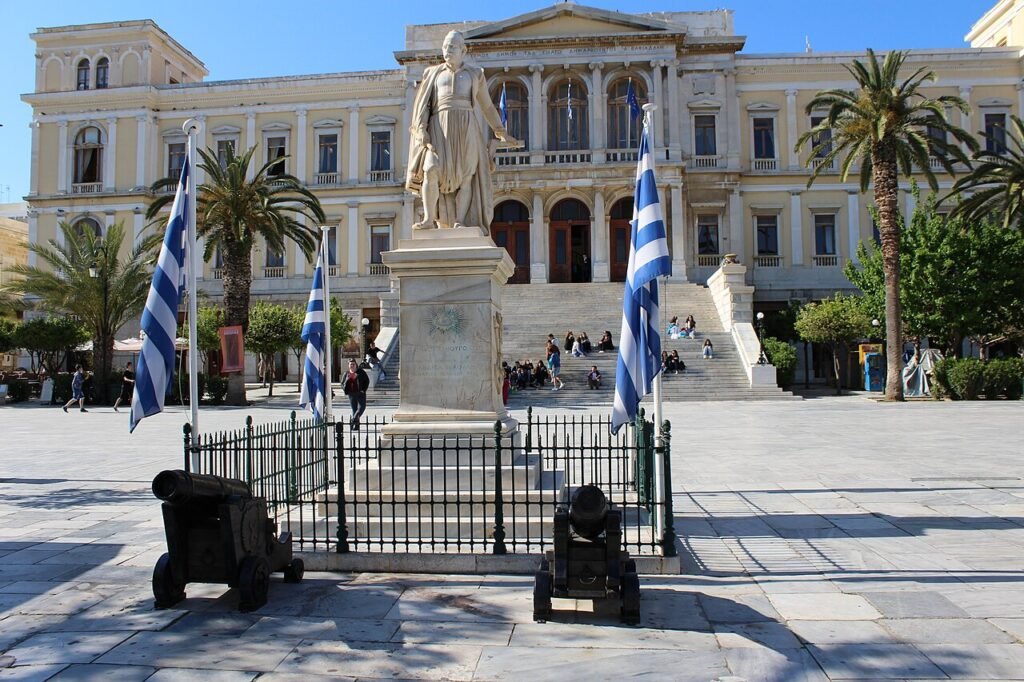
- Miaouli Square: the marble heart of the town, dominated by the neoclassical Town Hall designed by Ernst Ziller. Cafés line the square, and it is a great place to sit in the evening.
- The Apollo Theatre: a small opera house from 1864, inspired by La Scala in Milan. When there is no performance it can often be visited.
- Agios Nikolaos and Vaporia: the blue-domed Orthodox church of Agios Nikolaos stands in the elegant Vaporia neighbourhood of captains’ mansions, where locals swim straight off the rocks.

Ano Syros by Bus
High on the hill above Ermoupoli sits Ano Syros, the medieval town founded by the Venetians, and still home to the island’s Catholic community. We took the bus up and spent hours wandering its picturesque whitewashed lanes, stairways and arches. The views over Ermoupoli and the sea are fantastic. At the top stands the Catholic Cathedral of St George, and on the main street there is a small museum dedicated to Markos Vamvakaris, the rebetiko legend who was born here.
Is the bus to Ano Syros still free? Yes, as far as we can confirm. The Municipality of Syros-Ermoupoli runs free mini buses around town, including a line from the Agora stop in Ermoupoli up to Ano Syros. In the summer 2026 timetable (from 6 July 2026), it runs Monday to Saturday, several times in the morning and every hour in the evening, with no service on Sundays. Timetables change between summer and winter, so check the current one at the Agora stop or on the municipality’s announcements. A good tip is to ride up and walk back down through the lanes.

Galissas Beach
For a beach day we went to Galissas, on the west coast of the island. It is a sandy, sheltered bay with calm water, a few tavernas and a very relaxed atmosphere, and the sunsets there are beautiful. After the busy days on Santorini, it was exactly what we needed, and we truly recommend it.
Getting there: our bus to Galissas was free when we visited, but in 2026 the free municipal mini buses only run inside Ermoupoli. Galissas is served by the regional KTEL bus, which leaves from the bus station by the port, runs every day and costs a couple of euros, paid on board. Please check the current fares and times locally before you go.

Day 7: Blue Star Ferry from Syros to Piraeus, and On to Athens
On day 7, our last ferry took us from Syros to Piraeus, the port of Athens, in roughly four hours on the conventional Blue Star boats. Piraeus is huge, with many gates spread along the waterfront, so check which gate your ferry uses.
Getting from Piraeus Port to Central Athens
- Metro Line 1 (green): from Piraeus station, opposite the main ferry area, to Monastiraki in about 17 minutes, or on to Omonia. This is the easiest option for Plaka and the Acropolis area.
- Metro Line 3 (blue): also starts at Piraeus and goes directly to Syntagma in about 23 minutes.
- Tram: there is a tram from Piraeus towards Syntagma, but it is much slower, so only take it if your hotel is along the route.
- Transfer or taxi: with heavy bags, or if your ferry arrives late at night, a pre-booked Welcome Pickups transfer takes you straight to your hotel.
- Luggage: arriving before check-in, or flying out in the evening? Drop your bags with Radical Storage in the centre and explore hands-free.
Days 7 to 10: Athens and the Sights We Loved (3 Nights)
We spent three nights in Athens, which gave us two full days for sightseeing before flying home on day 10. Athens is big, noisy and full of history, and most of the major sights are within walking distance of each other in the centre. Entry to the Acropolis now works with timed slots, and lines can be long in summer, so we recommend booking your tickets in advance. Tiqets is a handy way to book the Acropolis, the Acropolis Museum and other Athens attractions with mobile tickets.
The Acropolis and the Parthenon
The Acropolis is the symbol of Athens and of ancient Greece. The Parthenon, the great marble temple to the goddess Athena, was built in the 5th century BC, at the height of Classical Athens. Next to it, look for the Erechtheion with its famous Caryatids, the elegant little Temple of Athena Nike and the monumental entrance, the Propylaea. Go at opening time or late in the afternoon to avoid the worst of the heat and crowds, wear shoes with good grip (the marble is slippery), and bring water. You can book skip-the-line entry with Tiqets.

The Acropolis Museum
At the foot of the hill, the modern Acropolis Museum is one of the best museums in Greece. Glass floors let you look down at the excavated remains of an ancient neighbourhood, the original Caryatids are displayed inside, and the top-floor Parthenon Gallery looks straight out at the Parthenon itself. Visit it on the same day as the Acropolis to understand everything you have just seen. Tickets are also available through Tiqets.
Plaka and Anafiotika
Plaka is the old neighbourhood below the Acropolis, full of neoclassical houses, little squares, shops and tavernas. Climb up its lanes to Anafiotika, a tiny village of whitewashed houses built in the 19th century by workers from the Cycladic island of Anafi. It feels like you have stepped back onto an island, right in the middle of the city.

The Ancient Agora
The Ancient Agora was the heart of public life in ancient Athens, where citizens met, traded and debated. Don’t miss the Temple of Hephaestus, one of the best-preserved ancient Greek temples anywhere, and the Stoa of Attalos, rebuilt in the 20th century and now home to the Agora museum.
The Temple of Olympian Zeus and Hadrian’s Arch
Only a handful of its giant columns are still standing, but the Temple of Olympian Zeus was once one of the largest temples in the ancient world. Work started in the 6th century BC, and it was only completed centuries later by the Roman emperor Hadrian, whose arch stands right next to the site.

The Panathenaic Stadium
A short walk from the Temple of Olympian Zeus, the Panathenaic Stadium is built entirely of white marble and hosted the first modern Olympic Games in 1896. You can walk on the track, climb to the top rows for the view and see a small exhibition of Olympic torches.

Monastiraki
Monastiraki Square is lively at any time of day, with views of the Acropolis, street food and the famous flea market streets selling everything from sandals to antiques. It is also a great place to try souvlaki or gyros, and the rooftop bars around the square are perfect for a drink facing the illuminated Acropolis at night.
Lycabettus Hill
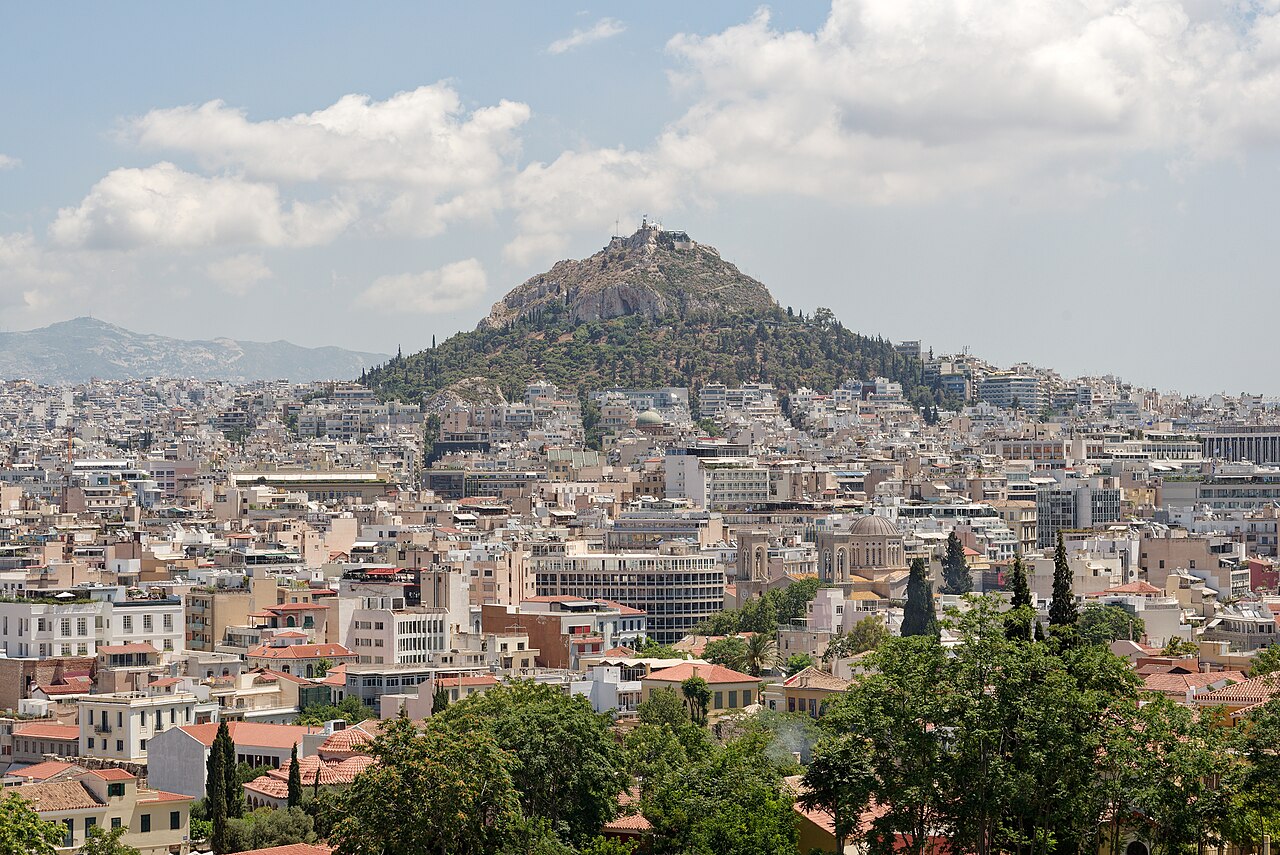
For the best panoramic view of Athens, go up Lycabettus Hill, the highest point in the city centre, with the little chapel of Agios Georgios at the top. You can hike up through the pine trees or take the funicular from the Kolonaki district. Sunset from here, with the Acropolis glowing and the sea in the distance, is unforgettable.
The Changing of the Guard at Syntagma Square
One of our favourite moments in Athens was watching the Changing of the Guard in front of the Greek Parliament on Syntagma Square. The guards are the Evzones of the Presidential Guard, an elite ceremonial unit of volunteers from the Greek Army’s infantry. They guard the Tomb of the Unknown Soldier around the clock, in every kind of weather, and the pair on duty changes every hour, on the hour.
Every Sunday at 11:00, there is a bigger official ceremony: a large group of Evzones marches with a military band from the Presidential Guard barracks to the Tomb of the Unknown Soldier. Arrive early if you want a spot at the front.
Every part of the uniform has a meaning:
- The fustanella: the white pleated kilt is made of about 30 metres of fabric and has 400 pleats, one for each year of Ottoman rule over Greece. Its white colour, like the shirt, stands for the purity of the fight for independence.
- The tsarouchia: the red leather shoes are handmade, weigh about 3 kg per pair and have around 120 nails in each sole. According to tradition, the big black pom-poms were used to hide small blades for close combat.
- The red cap (farion): it stands for the blood spilt during the struggle for freedom, and its long black tassel for tears and mourning.
- The blue and white fringes represent the Greek flag, and the uniform itself comes from the fighters of the Greek War of Independence of 1821.
The slow, high, perfectly synchronised steps are the most striking part of the ceremony. The movements follow a precise, rehearsed ritual, and the slow pace adds to the solemnity of honouring the fallen. Between changes, the Evzones stand completely still, and a fellow soldier sometimes comes by to straighten their uniform or wipe their face. Please be respectful: don’t touch the guards or step onto the area in front of the tomb, and keep your voice down during the ceremony.

Practical Tips for Island Hopping in Greece
Best Time to Go
- May, June and September are ideal, with warm seas, long days and fewer crowds than in peak summer.
- July and August are the hottest and busiest months, and the meltemi wind can make crossings rough and occasionally delay or cancel sailings.
- October can still be lovely, but some ferries, buses and seasonal businesses reduce their schedules or close.
Booking Ferries
- Book ahead in summer, especially on popular routes and weekends.
- Be flexible: on windy days keep a buffer day before an important flight from Athens.
- Conventional ferries like Blue Star are slower but steadier and usually cheaper than high-speed catamarans.
- Arrive at the port at least 30 to 60 minutes before departure, and have your ticket ready on your phone.
What to Book Ahead
- Accommodation for June to September.
- Your scooter in Santorini in peak season, and check that your licence covers it.
- Port and airport transfers, for example with Welcome Pickups.
- Luggage storage for check-out days, for example with Radical Storage.
- Acropolis and museum tickets in Athens, for example with Tiqets.
Santorini by scooter, the ancient gate of Naxos, the quiet lanes of Ano Syros, a lazy afternoon at Galissas and the history of Athens: this route shows how different the Greek islands can be from one another. Take the slow ferries, eat well, and enjoy every sunset. Kalo taxidi!
More Greece Travel Guides
Planning more of Greece? Read our 5 Days in Santorini and Mykonos itinerary for the full Santorini plan, and head to our Greece Travel Guide for the best places to visit, food to try, culture tips and all our Greek island itineraries.