
Santorini and Mykonos are the two Greek islands almost everyone dreams about, and the good news is that you can see both in a single, well-paced trip. In five days you get Santorini’s whitewashed villages hanging over the volcanic caldera, a scenic ferry ride through the Cyclades, and the windmills, alleys and sunsets of Mykonos, all without renting a car.
This itinerary uses public buses and the ferry, so it works for budget travellers as well as anyone who simply wants to avoid driving on narrow island roads. Bus times, fares and ferry schedules change every season, so treat the figures below as a guide and check them again before you travel.
This was our second trip to Greece. On our first, we hopped from Santorini to Naxos, Syros and Athens by ferry, which you can read about in our 10 Days of Greek Island Hopping guide.

Your 5-Day Itinerary at a Glance
- Day 1, Santorini: settle into Fira (Thira), visit its Orthodox and Catholic cathedrals, and walk the caldera path for photos.
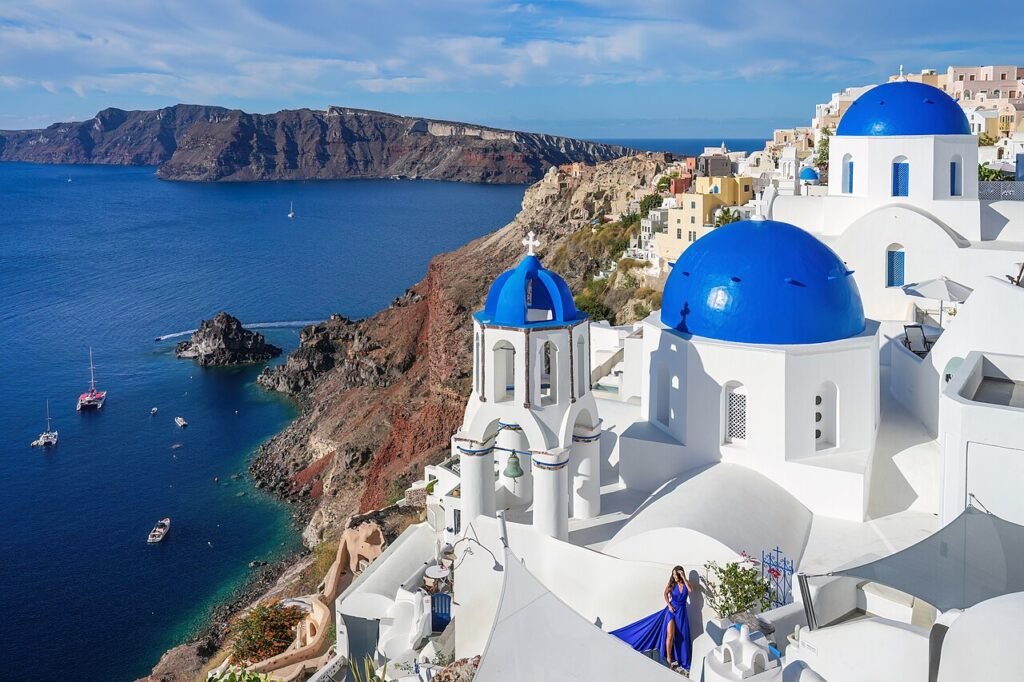
- Day 2, Santorini: take the KTEL bus to Oia for blue domes, windmills, Ammoudi Bay and lunch or dinner at Emfasis.
- Day 3, Santorini to Mykonos: ride the Seajets ferry past Naxos and Paros, then explore Mykonos Town (Chora), Little Venice and Petros the Pelican.
- Day 4, Mykonos: beach day at Ornos by local bus, or Paraga near Scorpios, then sunset and dinner by the Old Port.
- Day 5, departure: transfer to Mykonos Airport by bus, taxi or pre-booked transfer.
Day 1: Fira (Thira), Santorini’s Lively Capital
Fira is the most practical base on Santorini. It’s the island’s main bus hub, it has plenty of places to eat at every price level, and the views over the caldera are just as dramatic as in the more expensive villages. Drop your bags, grab a freddo espresso and start walking.
The Orthodox Metropolitan Cathedral
Fira’s main Greek Orthodox church is the Metropolitan Cathedral, dedicated to the Presentation of Christ (Ypapanti). You’ll find it in the centre of town, close to the Museum of Prehistoric Thera. Its bright white walls, arches and bell tower make it one of the most photographed buildings in Fira. Step inside to see the painted interior, and dress modestly (shoulders and knees covered).

The Catholic Quarter and the Cathedral of St John the Baptist
Santorini has had a Catholic community for centuries, and Fira still has a small Catholic Quarter in the upper, northern part of town. Its centrepiece is the Catholic Cathedral of St John the Baptist, easy to recognise by its pastel facade and tall bell tower, which looks quite different from the island’s typical Orthodox churches. The Dominican convent is close by, and the quiet lanes around it are a lovely break from the busy main streets.

Best Photo Spots in Fira
- The caldera path: the cliff-top walkway running north from Fira gives you classic views over the caldera and the volcanic islet of Nea Kameni.
- The Three Bells of Fira: a Catholic church (dedicated to the Dormition) with a much-photographed three-bell tower, on the edge of the caldera on the way towards Firostefani. Please don’t climb onto church roofs or walls for photos.
- The Old Port steps: look down the zigzag stairway to the old harbour, or ride the cable car down and back.
- Firostefani at sunset: keep walking north for about 15 to 20 minutes for quieter viewpoints and a great sunset over the caldera.
Tip: when cruise ships are in, the centre of Fira gets very busy from late morning. Explore early or later in the afternoon if you can.
Day 2: The KTEL Bus to Oia, Santorini’s Postcard Village
Taking the Bus from Fira to Oia
Santorini’s public buses are run by KTEL, and all the main routes start from the bus station in central Fira. The Fira to Oia line is one of the busiest on the island.
- Journey time: about 20 to 30 minutes, but allow much longer in summer traffic, especially before sunset when the whole island heads to Oia.
- Frequency: in the summer timetable, buses run roughly every 30 minutes from early morning into the evening. Off-season there are fewer departures and the last bus leaves earlier.
- Fare: €2.20 one way according to KTEL’s 2026 fare table. You can buy your ticket on the bus, and it’s best to carry cash. Prices change, so check before you go.
- Coming back: the return queue after sunset can be very long. Leave a little early, or plan dinner in Oia and catch a later bus if one is running.
Oia’s Photo Spots (and How to Beat the Queues)
Oia is beautiful, but it’s also one of the most crowded places in Greece in summer. The famous viewpoints are small, and at peak times you may queue for your turn at the best angle. The trick is timing: arrive early in the morning, and you’ll have the lanes almost to yourself.
- The blue domes: the iconic blue-domed churches viewed from the main path. Go before about 9am for photos without a crowd.
- The castle and sunset point: the ruins of the old castle at the western tip of the village are the classic sunset spot. People claim their place one to two hours before sunset, so either arrive very early or watch from a terrace or another viewpoint nearby.
- The windmills: Oia’s windmills look fantastic against the evening light, and they get busy around sunset too.
- Ammoudi Bay: about 300 steps lead down from Oia to this little harbour with red volcanic cliffs and fish tavernas by the water. Remember that you’ll have to climb back up.
- Respect the locals: many of the rooftops and terraces in the photos belong to hotels or private homes. Stay on public paths and never step onto a roof or church courtyard just for a picture.

Eating at Emfasis Restaurant in Oia
For a meal with a view, Emfasis Restaurant sits on the caldera cliffs of Oia, overlooking the Aegean and the village’s blue domes. It serves brunch, lunch and dinner with a Mediterranean menu built on seasonal ingredients. The signature dishes include fisherman’s pasta with the day’s seafood, pappardelle with prawns and grilled beef fillet, and brunch has omelettes, Greek yoghurt and eggs Benedict. Tables with a view go fast around sunset, so book ahead by phone or email through their website.
More to Enjoy in Oia
- Stroll the marble-paved main street, lined with galleries, jewellers and boutiques.
- Browse Atlantis Books, a much-loved independent bookshop tucked into a cave-style house.
- After sunset, enjoy a slower dinner in Oia once the day-trippers have left.
Day 3: Seajets Ferry from Santorini to Mykonos
Getting to Athinios Port
Ferries to Mykonos leave from Athinios, Santorini’s main port, about 8 km below Fira. KTEL buses connect Fira and the port (around €2.70 and roughly 20 minutes), and they are timed around ferry departures. Check the times at Fira bus station the day before. The road down to the port winds down the cliff and gets congested when several boats leave together, so aim to arrive about an hour early.
The Route: Past Naxos and Paros
Seajets runs most of the high-speed sailings on this route. The direct boats take around two hours, while the popular morning sailings via Naxos and Paros take roughly two and a half to three hours. The stops are a bonus, not a hassle: you get a quick look at two more Cycladic islands as the boat pulls into their harbours, before continuing north to Mykonos.
- The route is seasonal, running roughly from spring to autumn, with the most sailings from June to September.
- Timetables, vessels and stops change from season to season and sometimes day to day, so check the exact route when you book.
- Book ahead in July and August, when boats fill up.
- The sea can be choppy on windy days (the summer meltemi), so take seasickness tablets if you need them.

Arriving in Mykonos: New Port vs Old Port
Ferries from Santorini dock at the New Port in Tourlos, about 2 to 2.5 km north of Mykonos Town (Chora). The Old Port, right in town, is mainly used by small boats, Delos excursions and cruise tenders. From the New Port you can:
- take the Sea Bus, a small boat that runs to the Old Port roughly every 30 minutes in season (around €2 to €2.50),
- catch the KTEL bus into town,
- join the taxi queue, which can be long when several ferries arrive together, or
- arrange a hotel transfer in advance, which is the easiest option if you have heavy luggage or are staying outside town.
Days 3 and 4: Exploring Mykonos Town
Mykonos Town, or Chora, is made for wandering. Its maze of whitewashed lanes, painted doors and bougainvillea was famously designed to confuse pirates, and today it confuses visitors just as well. Getting lost is half the fun.
The Windmills of Kato Mili
The row of windmills on the hill above Little Venice is the symbol of Mykonos. Once used to grind grain, they are now the island’s favourite photo stop, especially in the golden hour before sunset.

Little Venice
Just below the windmills, Little Venice is a row of old houses built right on the edge of the sea, with colourful wooden balconies hanging over the water. On windy days the waves splash the tables of the bars below, so choose your seat carefully.

Panagia Paraportiani
In the old Kastro area next to Little Venice stands Panagia Paraportiani, one of the most photographed churches in Greece. It’s actually a cluster of small chapels joined into one sculptural, brilliantly white building, and it looks different from every side.

Matoyianni Street and the Chora Alleys
Matoyianni is the main shopping street of Chora, packed with boutiques, jewellers and cafés, and it’s at its liveliest in the evening. Turn off into the side alleys to find tiny chapels, cat-filled corners and quieter tavernas. Other things to do in town include the Archaeological Museum near the Old Port and the Folklore Museum in the Kastro area. If you have extra time, take a half-day boat trip from the Old Port to the ancient sanctuary of Delos.
Meet Petros the Pelican
Don’t be surprised if a large pink-and-white pelican waddles past you near the harbour. Petros the Pelican has been the mascot of Mykonos for decades. The story goes that in 1958 a local fisherman found an injured pelican after a storm and nursed it back to health. The bird refused to leave, and the islanders named it Petros. It became a celebrity and posed for countless postcards, until it died in 1986 after being hit by a car.
The island couldn’t imagine life without a pelican. Jacqueline Kennedy Onassis, a regular visitor to Mykonos, is said to have donated a female pelican named Irini, and a zoo in Hamburg sent a young male who inherited the name Petros. Later another injured pelican, Nikolas, was rescued and stayed. Today several pelicans roam Chora and the waterfront, and there’s always one called Petros. Please admire them from a respectful distance and don’t feed them.

Best Sunset Spots in Mykonos
- Little Venice: the classic choice. Get a drink at a waterfront bar such as Caprice or Galleraki, and arrive early for a front-row table.
- Kato Mili windmills: free, and with a wide view over Little Venice and the sea.
- Armenistis Lighthouse: about 6 to 7 km north of town, a quieter spot with wide-open views. You’ll need a taxi, scooter or car to get there.
- Scorpios at Paraga: the beach club is known for its sunset atmosphere. Expect high prices and book in summer.
The Old Port Waterfront and Its Restaurants
The Old Port is the heart of Chora, a curve of waterfront cafés, fishing boats and evening strollers. For dinner nearby, try:
- Kounelas, a long-running fish taverna tucked into a lane just off the harbour, with a vine-shaded courtyard. They take reservations.
- Niko’s Taverna, a classic for traditional Greek dishes, a short walk from the port towards Little Venice. It’s walk-in only, so come early.
- The waterfront cafés along the harbour, perfect for a sunset drink with the boats bobbing in front of you.

Day 4: Beach Day by Bus, Ornos or Paraga
Ornos Beach
Ornos is one of the easiest beaches to reach from town. It’s a sheltered, sandy bay that suits families and swimmers, with beach bars, tavernas and sunbed rentals. Buses leave from the Fabrika bus station (Agios Loukas Square, on the southern edge of Chora near the windmills). The ride takes about 10 minutes, and buses run roughly every 30 to 60 minutes in season, with fewer off-season. The fare is around €2.

Alternative: Paraga Beach, near Scorpios
If you’d prefer a livelier beach, take the Fabrika to Paraga bus instead. Paraga is a pretty bay on the south coast with beach bars and tavernas. The famous Scorpios beach club and restaurant sits on the headland at the end of Paraga, a short walk from the bus stop. In summer, buses run roughly hourly, but off-season there may be only a couple a day, so check the return times at Fabrika before you set off. If you want a sunbed or a table at Scorpios, book ahead.
Good to know: Mykonos Town has two main bus terminals that aren’t connected by bus. South-coast beaches like Ornos and Paraga leave from Fabrika, while the New Port and northern beaches are served from the Old Port area. Allow 15 to 20 minutes to walk between them.
Day 5: Getting to Mykonos Airport
Mykonos Airport (JMK) is only about 3 to 4 km from town, so the trip is short:
- KTEL bus: from Fabrika, about 10 minutes, around €2. Buses run roughly hourly in season. Check the timetable at the station.
- Taxi: usually around €17 to €25. Taxis are limited in high season, so book ahead or leave plenty of time.
- Pre-booked transfer: the most stress-free option with luggage, and many hotels can arrange one.
Airport queues can be long in July and August, so plan to arrive at least two hours before your flight.
Practical Tips for Santorini and Mykonos
Best Time to Visit
- May, June and September are ideal, with warm seas, long days and fewer crowds than in peak summer.
- July and August are the hottest, busiest and most expensive months, and the meltemi wind can make ferry rides bumpy.
- October can still be lovely, but some ferries, buses and beach businesses reduce their schedules or close.
Budget Notes
- Public buses cost only a few euros per ride, which is a big saving compared with taxis.
- Caldera-view hotels in Santorini and anything in central Mykonos are expensive in summer. Staying in Fira usually costs less than staying in Oia.
- Sunset-view restaurants and beach clubs charge a premium. A gyros or a bakery lunch keeps costs down.
- Carry some cash for buses and small tavernas.
What to Book Ahead
- Accommodation, especially for June to September.
- Your Seajets ferry ticket from Santorini to Mykonos.
- Sunset dinners, such as Emfasis in Oia, plus Scorpios if you’re going.
- Airport or port transfers if you have lots of luggage.
- A Delos boat trip if you plan to add one.
Five days is short, but this route gives you the best of both islands: Santorini’s volcanic drama and Mykonos’s cosmopolitan charm. Pack comfortable shoes for all those steps, keep your camera ready, and enjoy the Cyclades!
More Greece Travel Guides
Planning more of Greece? Head to our Greece Travel Guide for the best places to visit, food to try, culture tips and all our Greek island itineraries.