
This trip was all about two of Italy’s great cities: Florence, where the Renaissance still feels alive on every corner, and Rome, where you walk past two thousand years of history on the way to lunch. We had five days, a night flight into Rome, and fast trains between the two cities. It was busy, it was full of beautiful moments, and it worked really well as a family trip.
We started and finished in Rome, with two full days in Florence in between, so the route was simple: Rome, train to Florence, train back to Rome, and the Leonardo Express to the airport. In Florence we walked everywhere, and in Rome we got around mainly on Cooltra shared scooters, with the metro now and then, for example to the Vatican.
This post contains affiliate links; we may earn a small commission at no extra cost to you.

Our 5-Day Route at a Glance
- Arrival night, Rome: a night flight into Rome, the Fontana di Trevi lit up after dark, and a night near Roma Termini.
- Day 1, Rome to Florence: morning train to Firenze Santa Maria Novella, then the Basilica of Santa Maria Novella, Piazza della Signoria and Palazzo Vecchio, pizza at Pizza Napoli 1955, the Ponte Vecchio, the view from Piazzale Michelangelo, Santa Croce, and dinner at Il Profeta.
- Day 2, Florence: a guided climb of Brunelleschi’s dome, porchetta at Antica Porchetteria Granieri 1916, and the Uffizi Gallery, with the Vasari Corridor, Palazzo Pitti and Michelangelo’s David as options.
- Day 3, Florence to Rome: morning train back to Rome, a base on Via Nazionale, Cooltra shared electric scooters, the Colosseum, Roman Forum and Palatine Hill, lunch in Trastevere, then the Pantheon, the Trevi Fountain by day and the Spanish Steps.
- Day 4, the Vatican: Metro Line A to the Vatican, the Vatican Museums and the Sistine Chapel, St Peter’s Basilica and Square, a walk to Castel Sant’Angelo, and dinner around Piazza Navona.
- Day 5, departure: the Leonardo Express from Roma Termini to Fiumicino airport.
Arrival Night: Landing in Rome and the Trevi Fountain After Dark
We took a night flight into Rome, and instead of going straight to bed we dropped our bags at the hotel near Roma Termini and went to see the Fontana di Trevi. Seeing it at night, lit up and a little calmer than during the day, is a wonderful way to start a trip to Italy. The tired legs were completely worth it.
Arriving late with luggage, a pre-booked Welcome Pickups private transfer from Fiumicino or Ciampino to your hotel takes away all the stress of finding the right train or taxi rank at the end of a long day.

Sleeping near Termini was the practical choice: Rome’s main station is where the high-speed trains to Florence leave, so the next morning we simply walked to the platform. It is not the prettiest part of the city, but for a one-night stop before an early train it is hard to beat.
Day 1: Florence, From Santa Maria Novella to the Best View in the City
The high-speed train from Roma Termini to Firenze Santa Maria Novella takes about 1 hour 30 minutes on Trenitalia’s Frecciarossa or on Italo. We stayed close to Santa Maria Novella station in Florence, which is very handy: you arrive, drop your bags, and the historic centre is a short walk away. Florence is compact, and we did the whole city on foot: no buses, no taxis, just walking from one sight to the next. If your room is not ready yet, Radical Storage has luggage storage points near the station, so you can start exploring straight away.
The Basilica of Santa Maria Novella
Right next to the station, and the reason it carries the same name, is the Basilica of Santa Maria Novella. Its green and white marble façade was completed in 1470 to a design by Leon Battista Alberti, one of the great architects of the early Renaissance. Inside are treasures such as Masaccio’s Holy Trinity and Ghirlandaio’s frescoes in the Tornabuoni Chapel. Even if you only see it from the piazza, it is a beautiful first look at the city.

Piazza della Signoria and Palazzo Vecchio
From there we wandered through the historic centre to Piazza della Signoria, the political heart of Florence for centuries. We only saw the Palazzo Vecchio from the outside this time, with its tall tower rising over the square, but the piazza is an open-air museum in itself. The Loggia dei Lanzi shelters sculptures such as Cellini’s Perseus, and in front of the palace stands a copy of Michelangelo’s David, in the spot where the original stood until 1873.

Florence, Where the Renaissance Still Lives
Walking these streets, it is easy to understand why people say Florence is the city where Renaissance history lives the most. The streets still keep that feeling alive. This is where Leonardo da Vinci trained as a young artist, where Michelangelo grew up and carved his David, where Machiavelli worked for the Republic and wrote about power, and where the Medici family turned their wealth into art, architecture and patronage that changed Europe. You walk the same streets they walked, past the same palaces and churches, and that is a special feeling.
Lunch at Pizza Napoli 1955 and the Ponte Vecchio
Before crossing the Ponte Vecchio we stopped for lunch at Pizza Napoli 1955, on Via dei Neri, a few minutes’ walk from the Uffizi and the river. It serves proper Neapolitan pizza, with a soft, puffy crust, and we loved it. It is informal, good value for the centre, and exactly the fuel you need for an afternoon of walking.
Then came the Ponte Vecchio, the medieval bridge over the Arno, rebuilt in 1345, with little shops hanging off both sides. Since 1593 those shops have belonged to goldsmiths and jewellers, after Grand Duke Ferdinando I moved the butchers out. It was also the only bridge in Florence that the retreating German army did not destroy in 1944.

Piazzale Michelangelo: the Best View of Florence
After crossing the bridge, we walked along the river through the San Niccolò area and up to the famous viewpoint at Piazzale Michelangelo. It is a big panoramic terrace designed by Giuseppe Poggi in the 1860s, with a bronze copy of the David in the middle, and it really does give you the best view of Florence: the Duomo, Palazzo Vecchio’s tower, the bridges over the Arno and the hills all around. It is the place for great family photos, especially in the late afternoon light.
On the way back down we went through a beautiful garden and quiet streets. Just below the terrace is the Giardino delle Rose, a free public rose garden with lovely views of the city, and the Rampe del Poggi, the terraced paths and stairs that lead down to San Niccolò. Either way, the descent is part of the pleasure, so take your time.
Santa Croce, Where Great Italians Are Buried
Our last visit of the day was the Basilica of Santa Croce, the great Franciscan church on the square of the same name. It is sometimes called the Temple of Italian Glories, because so many famous Italians are buried here: Michelangelo, Galileo Galilei, Niccolò Machiavelli and the composer Gioachino Rossini, among others. There is also a monument to Dante, but it is a cenotaph; the poet died in exile and is buried in Ravenna. Standing between those tombs is a very moving way to end a day spent walking in their footsteps.

Dinner at Il Profeta
For dinner we went to Ristorante Il Profeta, on Borgo Ognissanti, not far from our hotel near the station. It is a very cosy, family-run Italian restaurant, open since 1979, with handmade pasta and warm, friendly service. Their best-known dish is the Bontà del Profeta, which they also call the “John Travolta Special”. It is a small place, so booking ahead is a good idea.
Day 2: Climbing Brunelleschi’s Dome, Porchetta and the Uffizi
A Guided Climb of the Duomo
The next day started with a guided tour to climb the Duomo, Florence’s Cathedral of Santa Maria del Fiore. Construction began in 1296, but for decades nobody knew how to cover the enormous space over the altar. Filippo Brunelleschi finally solved the problem, building the dome between 1420 and 1436 with two shells, a herringbone brick pattern and machines he designed himself, without the traditional wooden framework supporting it from the ground. Nearly six centuries later, it is still the largest masonry dome in the world.
The climb is 463 steps, with no lift, and some narrow passages, but halfway up you walk around the inside of the dome, right under the huge Last Judgment frescoes by Vasari and Zuccari, and at the top the whole city is at your feet. A guide makes a big difference here, because the story of how the dome was built is half the fun.
As of 2026, the official Brunelleschi Pass is €30 for adults and €12 for children aged 7 to 14 (free under 7). It includes the dome, Giotto’s Bell Tower, the Baptistery, the Opera del Duomo Museum and Santa Reparata. Dome slots are fixed and cannot be changed, and they sell out in busy periods, so book well ahead on the official Duomo site, or look for a guided climb on Tiqets.

Lunch: Porchetta at Antica Porchetteria Granieri 1916
After all those steps we had earned a good lunch, and we found it at Antica Porchetteria Granieri 1916, on Via Porta Rossa, close to the Mercato Nuovo. If you have never tried it, porchetta is one of central Italy’s great street foods: a whole pig, or a large cut of pork, deboned, seasoned generously with garlic, rosemary, wild fennel, salt and pepper, rolled up and slowly roasted until the meat is juicy and the skin turns into crunchy crackling. It is sliced to order and served in a crusty bread roll. Simple, filling and absolutely delicious.
The Uffizi Gallery
In the afternoon we visited the Uffizi Gallery, one of the greatest art museums in the world. The building itself was designed by Giorgio Vasari from 1560 as offices (uffizi) for Cosimo I de’ Medici, and today its long corridors hold masterpieces such as Botticelli’s Birth of Venus and Primavera, Leonardo da Vinci’s Annunciation, Michelangelo’s Doni Tondo and works by Raphael, Titian and Caravaggio. Give yourself at least two or three hours, and book a timed entry, either on the official Uffizi site or through Tiqets.

The Vasari Corridor: the Medici’s Private Passage
One of the most fascinating stories here is the Vasari Corridor. In 1565 Cosimo I de’ Medici asked Vasari to build an elevated, enclosed passage from Palazzo Vecchio, through the Uffizi, over the top of the Ponte Vecchio and across the river to Palazzo Pitti, the family’s new residence. It was built in only a few months, for the wedding of Cosimo’s son Francesco to Joanna of Austria, so the Medici could move between their palaces without mixing with the crowds in the streets. Look up when you cross the Ponte Vecchio and you will see the row of small windows running along the top of the shops.
After a long restoration, the corridor reopened to visitors in December 2024. As of 2026, you visit it with a named Uffizi plus Vasari Corridor ticket (€47 booked in advance, €43 on the day), with a fixed time slot from Tuesday to Sunday. The route runs one way, from the Uffizi over the river to the Boboli Gardens, and you must enter the Uffizi two hours before your corridor slot, so plan the day around it.
Palazzo Pitti and Michelangelo’s David
On the other side of the river, Palazzo Pitti is also worth seeing if you have time, at least from the outside. The huge palace became the main home of the Medici grand dukes, and today it holds several museums, with the Boboli Gardens climbing the hill behind it.
And yes, Michelangelo’s original David is in Florence, at the Galleria dell’Accademia, where it has been since 1873. We did not go in this time, but if you have an extra half-day, it is one of the most famous sculptures in the world and well worth it. The copies in Piazza della Signoria and at Piazzale Michelangelo give you an idea of its size, but the original, more than five metres tall, is something else. The Accademia is usually closed on Mondays, and tickets can be booked in advance, for example with Tiqets.
Day 3: Back to Rome, Shared Scooters, Ancient Rome and Trastevere
The next morning we took the train back to Rome. On check-out days like this, leaving your bags with Radical Storage near Santa Maria Novella or Roma Termini lets you keep enjoying the city without dragging suitcases around.
Where We Stayed in Rome: Via Nazionale
In Rome we stayed on Via Nazionale, and it was a really handy base. It is a short walk from Termini, close to the Repubblica metro station on line A, and many bus lines run along the street towards Piazza Venezia, the historic centre and the Vatican. You can also walk to the Trevi Fountain and the Quirinale from there.
Getting Around on Cooltra Shared Electric Scooters
Our main way of getting around Rome was Cooltra, the shared electric scooter service; we only took the metro now and then, for example to the Vatican. It is not a daily rental like the scooter we had in Greece: you find a scooter on the map in the app, unlock it with your phone, pay by the minute and end the ride when you park. The scooters are moped-style electric scooters, equivalent to a 50cc, and there are two helmets in the top box. It was exciting, and it helped us shorten some of the longer distances between sights. That said, you need to stay relaxed with Rome’s traffic and know the streets a little, or simply be happy to get lost now and then. Cobblestones, buses and busy junctions keep you on your toes.
A few practical points, as of late 2026 (always check the app, because prices and rules change). Cooltra is still the scooter-sharing operator authorised by Roma Capitale. You need to be at least 18 and hold a valid driving licence; for these 50cc-equivalent scooters in Italy, an AM or a car (B) licence is enough. If your licence was issued outside the EU, you may also need an International Driving Permit. Registration is free, and the app checks your ID and licence before your first ride, so set it up before you travel. Cooltra lists Rome at €0.29 per minute, with battery charging, third-party insurance and helmets included. The scooters can carry two people, and you must end the ride in a permitted two-wheeler parking area inside the service zone shown in the app. Wear the helmet, always.
The Colosseum, the Roman Forum and Palatine Hill
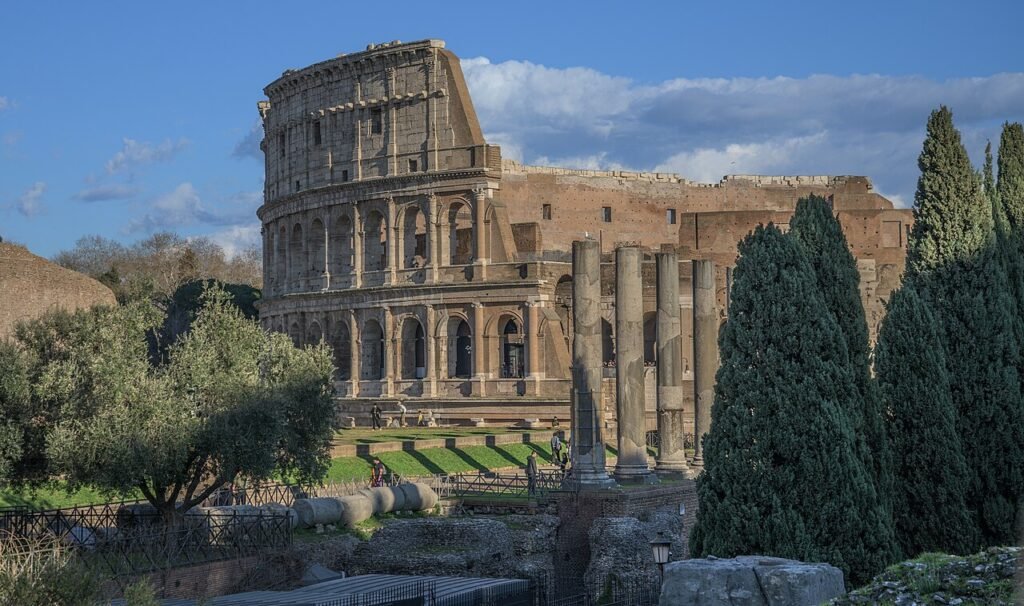
Our first stop was the Colosseum, the Flavian Amphitheatre, begun under Emperor Vespasian around AD 70 and inaugurated by his son Titus in AD 80. It could hold an estimated 50,000 spectators for gladiator fights and spectacles, and even with all the photos you have seen, standing inside it is impressive.
Right next to it are the Roman Forum, the centre of political, religious and commercial life in ancient Rome, with its temples, triumphal arches and the remains of the Senate House, and the Palatine Hill, where, according to legend, Romulus founded the city, and where the emperors later built their palaces. The word “palace” itself comes from Palatium, the Palatine.
As of 2026, the standard 24-hour ticket for the Colosseum, Roman Forum and Palatine is €18, with a timed entry to the Colosseum, and it is worth booking early, either on the official Colosseum site or through Tiqets. Wear comfortable shoes and bring water; there is very little shade in the Forum.
Lunch in Trastevere
For lunch we crossed the Tiber to Trastevere, one of Rome’s most picturesque neighbourhoods, with its narrow cobbled lanes, ivy-covered houses, little squares and the beautiful Basilica of Santa Maria in Trastevere. It is full of trattorias, and it is the perfect place to slow down, sit outside and enjoy a plate of pasta in the middle of a busy sightseeing day.
The Pantheon
In the afternoon we headed to the Pantheon. The temple you see today was built under Emperor Hadrian, around AD 113 to 125, although the inscription on the front still credits Marcus Agrippa, who built an earlier temple on the site. Its concrete dome, with the open oculus in the middle, is still the largest unreinforced concrete dome in the world. It has been a church since 609, which is a big part of why it survived so well, and the painter Raphael is buried inside. From 1 July 2026, the entrance ticket is €7.

The Trevi Fountain by Day
Having seen it at night on our first evening, we went back to the Fontana di Trevi to see it in daylight. Designed by Nicola Salvi and completed in 1762, it shows Oceanus riding a shell-shaped chariot pulled by sea horses, and it is fed by the Aqua Virgo, an aqueduct first built in 19 BC. Tradition says you should toss a coin with your right hand over your left shoulder to make sure you return to Rome.
If you are travelling now, note that since 2 February 2026 non-residents pay a €2 ticket to enter the area right next to the basin during the day (generally from 9:00 to 22:00). You can still see the fountain for free from the surrounding piazza, and later in the evening it is free again, which is one more reason we loved our night-time visit. Check the official site, fontanaditrevi.roma.it, for current hours.
Piazza di Spagna and the Spanish Steps
We finished the day at Piazza di Spagna, named after the Spanish Embassy to the Holy See. The Spanish Steps, built in the 1720s and largely paid for with French funds, climb up to the church of Trinità dei Monti, and at their foot is the Barcaccia, the boat-shaped fountain by Pietro Bernini and his son Gian Lorenzo. One thing to know: sitting on the steps is no longer allowed, and the local police do hand out fines.

Day 4: A Full Day at the Vatican, Castel Sant’Angelo and Piazza Navona
Our last full day in Italy was for the Vatican, and we wanted to see everything inside. If you enjoy museums, art and history, be warned: you will definitely spend a lot of time here, and you will still leave with things you did not see.
This was one of the days we left the scooters and took the Rome Metro. From Repubblica, the station closest to our hotel on Via Nazionale, Line A in the direction of Battistini takes you to Ottaviano or Cipro, the two stops the Vatican Museums recommend; from either one it is roughly a ten-minute walk to the museum entrance on Viale Vaticano, and Ottaviano is also handy for St Peter’s Square. As of 2026, a standard BIT ticket costs €1.50 and covers one metro ride (100 minutes on buses and trams). You can buy tickets at machines or in the ATAC app, or simply tap a contactless card or phone at the metro gates; with the same card, the daily charge is capped at the €8.50 price of a 24-hour ticket.
The Vatican Museums and the Sistine Chapel
The Vatican Museums are a whole world of their own, founded by Pope Julius II in the early sixteenth century. The highlights we would not miss are:
- The Sistine Chapel: Michelangelo’s ceiling, painted between 1508 and 1512, and his Last Judgment on the altar wall. Photos are not allowed, and visitors are asked to stay quiet.
- The Raphael Rooms: four rooms frescoed by Raphael and his workshop, including the famous School of Athens.
- The Gallery of Maps: a long corridor with 40 painted maps of Italy’s regions and a stunning gilded ceiling.
- The Pio-Clementino Museum: classical sculpture, including the Laocoön group and the Apollo Belvedere.
- The Pinacoteca: the picture gallery, with works by Giotto, Leonardo da Vinci, Raphael and Caravaggio.
- The Gallery of Tapestries, the Gallery of the Candelabra and the spiral staircase on the way out.

As of 2026, a full-price ticket bought on the official Vatican Museums website costs €20 plus a €5 online booking fee, and booking a timed entry is the only sensible way to avoid the long queues. The museums are usually closed on Sundays, except the last Sunday of the month, when entry is free and extremely crowded. Guided tours and skip-the-line options are also available through Tiqets. Remember the dress code: shoulders and knees covered.
St Peter’s Basilica and Square
Next comes St Peter’s Basilica, the largest church in the world, with Michelangelo’s Pietà, Bernini’s bronze baldachin over the papal altar, and the great dome designed by Michelangelo. Entry to the basilica itself is free, but expect security queues. If you still have energy, you can climb the dome: as of 2026 it costs €17 by the stairs (551 steps) or €22 with the lift for the first part. Outside, Bernini’s colonnade wraps around St Peter’s Square like two open arms.
Castel Sant’Angelo
From the Vatican we walked to Castel Sant’Angelo, beside the Tiber. It began life as the mausoleum of Emperor Hadrian, completed around AD 139, and over the centuries it became a fortress, a prison and a papal residence. Its relationship with the Vatican is direct: the Passetto di Borgo, a fortified passage running along the top of a wall, connects the Vatican to the castle. In 1527, during the Sack of Rome, Pope Clement VII escaped along it and took refuge inside the castle.
The name comes from a legend: in 590, during a terrible plague, Pope Gregory the Great is said to have seen the Archangel Michael on top of the mausoleum, sheathing his sword as a sign that the plague was over. A bronze statue of the angel still stands at the top today. Walk across Ponte Sant’Angelo, lined with Bernini’s angels, for the best view of the castle. Entry tickets are also available through Tiqets.

Piazza Navona and Dinner
We ended the day with a walk to Piazza Navona, one of Rome’s most beautiful squares. Its long oval shape follows the outline of the Stadium of Domitian, built in the first century AD, and in the middle stands Bernini’s Fountain of the Four Rivers, facing Borromini’s church of Sant’Agnese in Agone. In the streets around the piazza you will find lots of restaurants to choose from; the side streets are often a little calmer and better value than the tables on the square itself.

Day 5: Getting From Rome to Fiumicino Airport
On our last morning we took the Leonardo Express from Roma Termini to Fiumicino airport. It is Trenitalia’s non-stop service, taking about 32 minutes and costing €14 one way, with frequent departures. It is easy, reliable and comfortable with luggage. There are other good options too:
- Regional FL1 train: cheaper, at €8, but it does not stop at Termini. It is useful if you are staying near Trastevere, Ostiense or Tiburtina.
- Airport buses: companies such as Terravision, SIT Bus Shuttle and T.A.M. run coaches between Termini and Fiumicino. They are the cheapest option, but slower and dependent on traffic.
- Taxi: official Rome taxis charge a flat fare of €55 between Fiumicino and anywhere inside the Aurelian Walls, which covers most of the historic centre. Only use the official white taxis at the rank.
- Private transfer: if you have a lot of luggage, small children or an early flight, a Welcome Pickups private transfer picks you up at your hotel and takes you straight to the terminal, at a price agreed in advance.
Practical Tips for Florence and Rome
Getting Between the Cities and Around Rome
- Roma Termini to Firenze Santa Maria Novella takes about 1 hour 30 minutes on Frecciarossa (Trenitalia) or Italo. Book in advance for the best fares.
- Florence’s historic centre is compact: we walked everywhere and never needed a bus or taxi inside the city. Staying near Santa Maria Novella station also makes arrival and departure days easy.
- In Rome, Via Nazionale and the area around Termini are practical bases, with the metro, many buses and the airport train close by.
- Inside Rome we got around mainly on Cooltra shared scooters, walking in between, and took the metro now and then, for example to the Vatican. Metro Line A runs from Repubblica and Termini to Spagna (Spanish Steps) and to Ottaviano or Cipro for the Vatican; a ride costs €1.50, and you can tap a contactless card at the gates.
- The Leonardo Express to Fiumicino costs €14 and takes about 32 minutes; city bus and metro tickets are not valid on it.
What to Book Ahead
- The Brunelleschi Pass for the Duomo climb, which has fixed time slots, or a guided climb with Tiqets.
- The Uffizi, and the Vasari Corridor if you want to walk it, plus the Accademia for the David, for example with Tiqets.
- The Colosseum, Roman Forum and Palatine, and the Vatican Museums, which both sell out, for example with Tiqets.
- Luggage storage on train days, for example with Radical Storage, near Santa Maria Novella or Roma Termini.
- Airport transfers, for example with Welcome Pickups.
- A table at small, popular restaurants such as Il Profeta.
A Few Extra Tips
- Dress code: shoulders and knees covered for the Duomo, the Vatican Museums, St Peter’s and other churches.
- Wear comfortable shoes: between the dome climb, the Forum and the Vatican, you will walk a lot.
- If you plan to use Cooltra shared scooters, register in the app before the trip, bring your driving licence, wear the helmet from the top box and park only where the app allows.
- No sitting on the Spanish Steps, and expect a small ticket to get close to the Trevi Fountain during the day.
- Watch your belongings on the metro and at the busiest sights.
Five days went by far too fast, but it gave us the best of both cities: the Renaissance streets and views of Florence, and the ancient ruins, fountains and Vatican treasures of Rome. Italy always offers so much, from the food, the gelato and the perfect cappuccinos to the history around every corner and that vibrant energy you feel in every piazza, and we are already dreaming about the next trip.